
PRIVATE TOURS TO PELEȘ CASTLE
Peleș Castle is a Neo-Renaissance castle in the Carpathian Mountains, near Sinaia, in Prahova County, Romania, on an existing medieval route linking Transylvania and Wallachia, built between 1873 and 1914. Its inauguration was held in 1883. It was constructed for King Carol I. Construction saw a slight slowdown during the Romanian War of Independence against the Ottoman Empire in 1877–78, but soon afterwards the plans grew in size and construction was quite rapid. Peleș Castle had its official Royal Ball of Inauguration on 7 October 1883. King Carol I and Queen Elizabeth lived in Foişor Villa during construction, as did King Ferdinand and Queen Marie during the construction of Pelișor Castle. King Carol II was born at the castle in 1893, giving meaning to the phrase “cradle of the dynasty, cradle of the nation” that Carol I bestowed upon Peleș Castle. Carol II lived in Foișor Villa for periods during his reign.
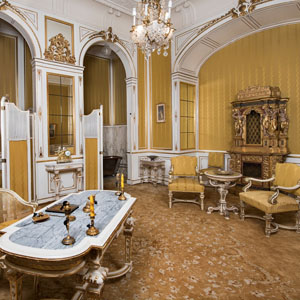

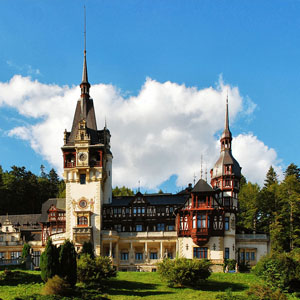


Peleş Castle has a 3,200-square-metre floor plan with over 170 rooms, many with dedicated themes from world cultures. Themes vary by function (offices, libraries, armouries, art galleries) or by style (Florentine, Turkish, Moorish, French, Imperial); all the rooms are lavishly furnished and decorated to the slightest detail. There are 30 bathrooms. The establishment has collections of statues, paintings, furniture, arms and armor, gold, silver, stained glass, ivory, porcelain, tapestries and rugs. The collection of arms and armour has over 4,000 pieces, divided between Eastern and Western war pieces and ceremonial or hunting pieces, spreading over four centuries of history. Oriental rugs come from many sources: Bukhara, Mosul, Isparta, Saruk and Smirna. The porcelain is from Sèvres and Meissen; the leather is from Córdoba. The hand-painted stained glass vitralios, which are mostly Swiss.
The Hall of Honour was finished completely only in 1911, under the guidance of Karel Liman. It spreads over three floors. Walls are dressed in exquisitely carved woodwork, mostly European walnut and exotic timbers. Bas-reliefs, alabaster sculptures, and retractable stained glass panels complete the decor.
The Imperial Suite is believed to be a tribute to the Austrian Emperor Franz Joseph I, who visited the palace as a friend of the Romanian Royal Family. Hence, decorator Auguste Bembe preferred the sumptuous Austrian Baroque in style of Empress Maria Theresa. A perfectly preserved five-hundred-year-old Cordoban tooled leather wall cover is the rarest of such quality.
The Grand Armory or The Arsenal is where 1,600 of the 4,000 pieces of weaponry and armor reside. One of Europe’s finest collection of hunting and war implements, timelined between 14th and 19th century, are on display. The king added pieces used in his victory against the Ottoman Turks during the War of Independence. Famous are the complete Maximilian armor for horse and rider and a 15th-century German “nobles only” decapitation broadsword. Also on display are a wide array of polearms (glaives, halberds, lances, hunting spears), firearms (muskets, blunderbusses, snaphaunces, flintlocks, pistols), axes, crossbows, and swords (rapiers, sabers, broadswords, and many others).
The Small Armory is where predominantly Oriental (mostly Indo-Persian, Ottoman and Arab) arms and armor pieces are on exhibit, many of them made of gold and silver, and inlaid with precious stones. Included are chainmail armor, helmets, scimitars, yataghans, daggers, matchlocks, lances, pistols, shields, axes, and spears.
The Playhouse is decorated in Louis XIV style, with sixty seats and a Royal Box. Architectural decoration and mural paintings are signed by Gustav Klimt and Frantz Matsch.
The Florentine Room combines revived elements of the Italian Renaissance, mostly from Florence. Most impressive are the solid bronze doors executed in Rome; ateliers of Luigi Magni; and the Grand Marble Fireplace executed by Paunazio with Michelangelo motifs.
The Moorish Salon was executed under the guidance of Charles Lecompte de Nouy, and is meant to embody elements of North-African and Hispanic Moorish style. Mother-of-pearl inlaid furniture, fine Persian Sarouk and Ottoman Isparta rugs, and Oriental weapons and armor are perhaps the most expressive elements. The salon has an indoor marble fountain.
The Turkish Parlor emulates an Ottoman “joie de vivre” atmosphere—a room full of Turkish Izmir rugs and copperware from Anatolia and Persia. It was used as a smoking room for gentlemen. Walls are covered in hand-made textiles like silk brocades from the Siegert shops of Vienna.

Services 24/7
Careful planning, door to door service, 24 hours a day.

Comfortable Cars
Different vehicles with varying passenger capacities.

Corporate Partners
We offer bonuses and discounts to firms and organisations.

Professional Drivers
Our drivers are best in the industry and highly trained for this task

